
 Moisture Determination by Improved On-Site Diagnostics (Part3)
Author: Maik Koch and Michael Krueger – Omicron Electronics Austria
Application at Onsite Measurements
Here the example of a heavily aged transformer dedicated for scrapping should be considered. Such a case delivers a good opportunity to compare different approaches to assess moisture content. Mineral oil type Shell Diala 6KX having a neutralization number of 0,49 mg KOH/g oil from 1954 filled the transformer. This high value together with an oil conductivity of 900 pS/m indicates a strong influence of conductive aging products and therefore a progressed aging state. Paper samples were taken after measuring the dielectric properties (polarization and depolarization currents, frequency domain spectroscopy) and oil sampling (moisture content in ppm, moisture saturation in %). Figure 9 depicts the measurement data of the dielectric measurements. The fast decaying currents in time domain and the high dissipation factor in frequency domain indicate a highly conductive insulation. Figure 10 (left) compares the moisture results of the different measurement and analysis approaches. Karl Fischer titration at paper samples came to 2,6 % moisture by weight (KFT). The analysis results of the dielectric response methods differ from each other: Two algorithms had no compensation for conductive aging products and determined 3,8 and 4 % moisture by weight (FDS, PDC). The new analysis software having a compensation for conductive aging products indicates 2,9 % moisture relative to weight (Dira).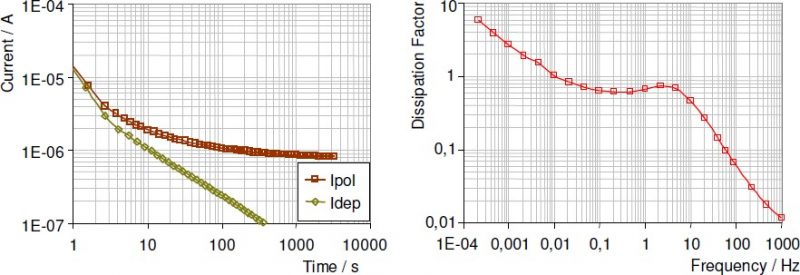
Figure 9. Left: polarisation currents measured between HV- and LV-winding Right: dissipation factor as measured between HV- and LV-winding
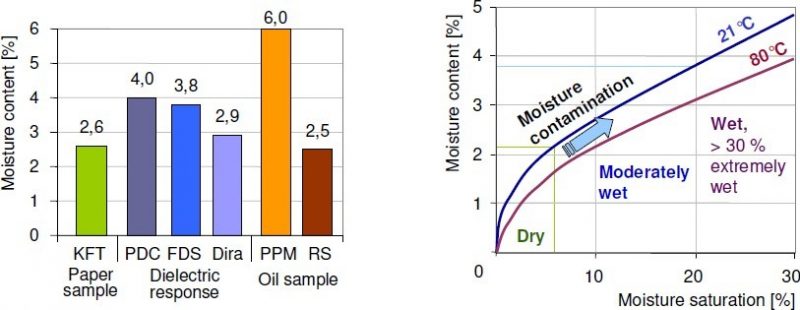
Figure 10. Left: moisture content in the solid insulation as obtained from various measurement methods Right: moisture sorption isotherm for a cellulose material relating moisture saturation to moisture content [3] with categories according to IEC 60422 [13]
Assessment of Moisture Results
IEC 60422 categorizes moisture saturations of more than 6 % as “moderately wet”, which is equivalent to a moisture content of approximately 2,2 %. In this area the water molecules become more and more active, causing the dangerous effects of water. At this level, maintenance actions such as drying should be considered taking into account the importance and future operation of the transformer. Figure 10 (right) shows the relationship between moisture content and moisture saturation which helps to assess the analyzed results.Summary
This paper discusses approaches to measure moisture in power transformers using dielectric response methods and equilibrium diagrams.- Dielectric diagnostic methods deduce moisture in the solid insulation from dielectric properties like polarisation depolarisation currents and dissipation factor frequency.
- A new instrument “Dirana” combines time domain (PDC) and frequency domain (FDS) measurements and thus substantially shortens the measurement
- A new software was developed which bases on a new data pool, measured at new and aged pressboard with various moisture contents and oil
- The new analysis algorithm compares measurements from a transformer to modelled dielectric responses, obtained from the so called XY-model. The new software features weighting of low frequency data and an extended XY-model.
- The analysis algorithm compensates for the influence of conductive aging by-products.
- The new software was successfully utilized for onsite measurements in comparison to other measurement and analysis
- The conventional application of equilibrium diagrams to derive moisture in cellulose (%) from moisture in oil (ppm) is effected by substantial
- To exclude the interference due to oil aging the moisture in oil relative to saturation level (%) is more appropriated instead of moisture in oil in
- One step forward constitutes the use of moisture relative to saturation in oil and This measure is easy, continually and accurate measurable.
References
- Koch, S. Tenbohlen: “The Breakdown Voltage of Insulation Oil under the Influence of Humidity, Acidity, Particles and Pressure”, International Conference on Advances in Processing, Testing and Application of Dielectric Materials APTADM, 26.-28.09.2007, Wroclaw.
- E. Lundgaard, W. Hansen, D. Linhjell, T. J. Painter: “Aging of oil-impregnated paper in power transformers”, IEEE Transactions on Power Delivery, Jan. 2004 Volume: 19, Issue 1, p. 230- 239.
- Koch, S. Tenbohlen, T. Stirl: “Advanced Online Moisture Measurements in Power Transformers” CMD 2006 International Conference on Condition Monitoring and Diagnosis, Changwon, Korea, 2006
- Koch, S. Tenbohlen, I. Hoehlein and J. Blennow: “Reliability and Improvements of Water Titration by the Karl Fischer Technique” Proceedings of the XVth International Symposium on High Voltage Engineering, ISH, Ljubljana, Slovenia, 2007
- M. Gubanski, P. Boss, G. Csepes, V.D. Houhanessian, J. Filippini, P. Guuinic, U. Gafvert, V. Karius, J. Lapworth, G. Urbani, P. Werelius, W. S. Zaengl: “Dielectric Response Methods for Diagnostics of Power Transformers” CIGRÉ Task Force 15.01, Technical Brochure 254, Paris, 2004
- S. Zaengl “Dielectric Spectroscopy in Time and Frequency Domain for HV Power Equipment, Part I: Theoretical Considerations” IEEE Electrical Insulation Magazine, Vol 19, No. 5 pp.5-18, September / October 2003
- Borsi, E. Gockenbach, M. Krueger “Method and Device for Measuring a Dielectric Response of an Electrical Insulation System” European Patent EP1729139
- Koch, S. Tenbohlen, M. Krüger and A. Kraetge: “A Comparative Test and Consequent Improvements on Dielectric Response Methods” Proceedings of the XVth International Symposium on High Voltage Engineering, ISH, Ljubljana, Slovenia, 2007
- Ekanayake: “Diagnosis of Moisture in Transformer Insulation”, Ph.D. dissertation, Dep. of Materials and Manufacturing Technology, Chalmers University of Technology, 2006
- Gafvert, G. Frimpong, and J. Fuhr: “Modelling of dielectric measurements on power transformers”, Proc. 37th Session “Large High Voltage Electric Systems” (CIGRE), paper 103, Paris, France, 1998
- Koch, S. Tenbohlen, D. Giselbrecht, C. Homagk, T. Leibfried: “Onsite, Online and Post Mortem Insulation Diagnostics at Power Transformers”, Cigré SC A2 & D1 Colloquium, Brugge, Belgium 2007
- V. Oommen: “Moisture Equilibrium Charts for Transformer Insulation Drying Practice” IEEE Transaction on Power Apparatus and Systems, Vol. PAS-103, No. 10, Oct. 1984, pp. 3063-3067
- Pahlavanpour, M. Eklund K. Sundqvist “Revised IEC Standard for Maintenance of In- Service Insulating Oil” Weidmann Third Annual Technical Conference, Sacramento, USA. 2004
- Du, M. Zahn, et al. “A Review of Moisture Equilibrium in Transformer Paper-Oil Systems” IEEE Electrical Insulation Magazine, Vol. 15, No. 1, pp. 11-20, January- February 1999